

Data centers are no longer allowed as a by-right use in the Town of Orange.
On Tuesday, town council members voted unanimously to amend the town’s zoning ordinance, removing data centers as a by-right use in the traditional town center (TTC) zoning district and change them from by-right to requiring a special use permit (SUP) in the town activity center (TAC), rural commercial (RC) and traditional industrial zoning districts (TI). Data centers are not permitted in the rural residential (RR), traditional residential low density (TR-L) and traditional residential high density (TR-H) districts. The council also voted to require an SUP for data centers in the Round Hill Traditional Neighborhood Development district.
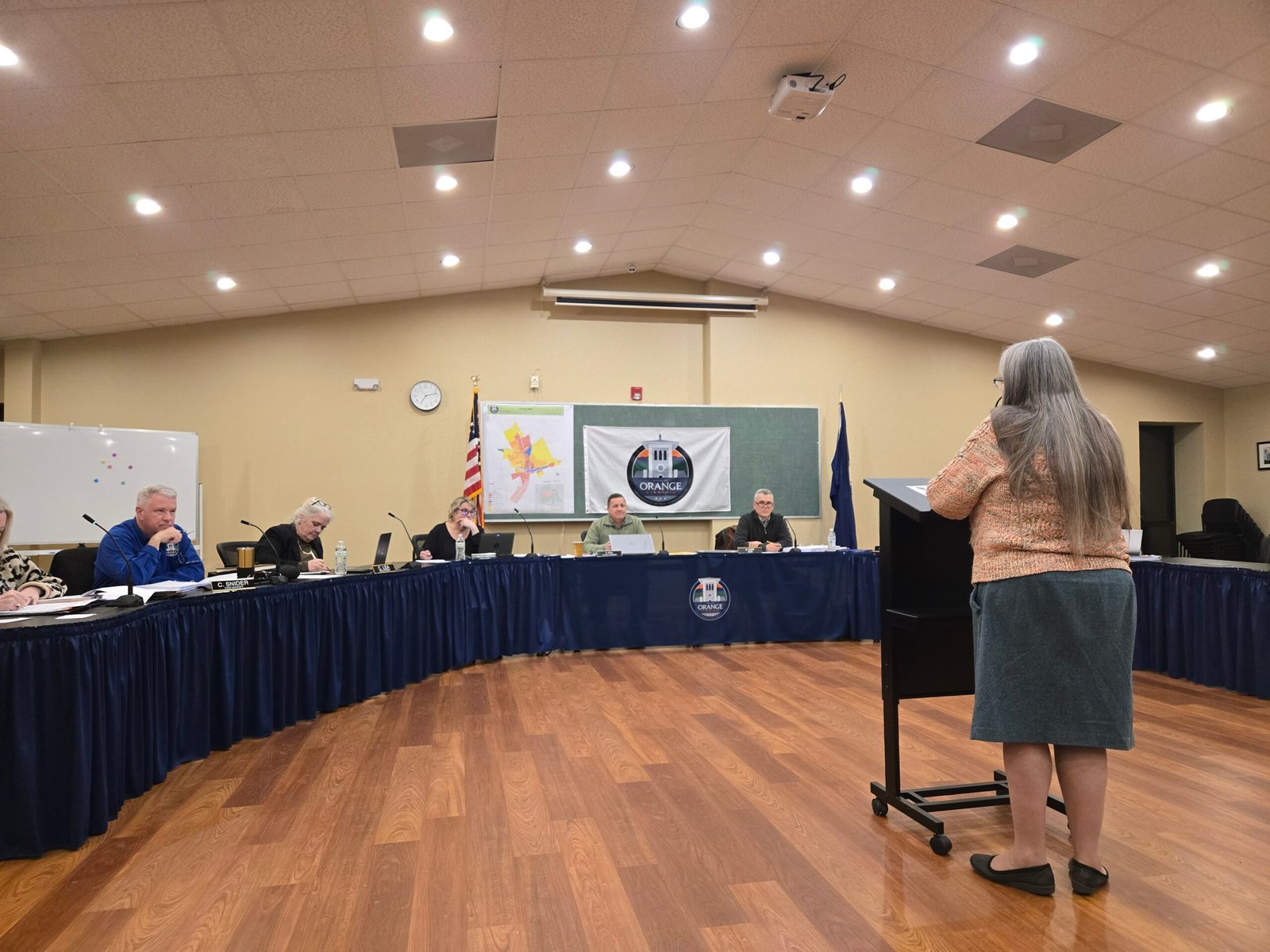
However, some residents don’t think just requiring a SUP is enough. During a public hearing that was held immediately prior to the vote, four town residents spoke in favor of the changes, but said more must be done.
David Rhoades said the town council should follow the county’s lead and put in stricter regulations. The Orange County Board of Supervisors recently approved a new floating technology district which would require a rezoning and a SUP for data centers, both of which come with regulations and opportunities for public input. The county planning commission is currently considering an additional ordinance amendment that would remove data centers as a by-right use in the industrial zoning district, the only district in which they were allowed.
Rhoades also suggested an “out right prohibition on data centers in town.”
Hillary Hicks agreed. She said she was concerned about how data centers could affect tourism.
“How many people want to stay in a bed and breakfast or hotel located near a data center?” she asked.
Ellen Sawaya said she, too, would like to see a ban on data centers within town limits. She said the use doesn’t fit. If one were to be located within the town, which she said would be a worst case scenario, the only appropriate area would be the town’s traditional industrial zone.
Richard Robinson cautioned that data centers are constantly evolving and could “destroy Orange” if the council isn’t careful.
Council member Jason Cashell agreed. He said requiring a SUP was a good step in the right direction, but more should be done to protect Orange. He said with the town’s small size, a data center located anywhere within the limits would affect everyone. While data centers do generate revenue for a locality which enables projects to be funded, Cashell said not all money is good money and not all growth is good growth. He questioned the impacts a data center would have on the environment, noise and tourism. He said they don’t bring local jobs and come with increased utility costs. He encouraged the protection of what makes Orange unique.
“If we protect the historical landmarks, beautiful countrysides, small town charm [and] history, it’s only going to draw more and more people to us,” Cashell said. “While every other town is selling out and chasing this money, the more we say ‘no’ the more special we become.
“I feel a strong conviction that I want to make clear we don’t allow data centers in this small charming town in Virginia,” he added.
Mayor Harrison Cluff, who grew up in the town, said while he respects and appreciates the history in the area, it would be premature to ban data centers without fully researching the issue.
“We must dig into it deeper,” he said. “Do I say we throw the doors open to a data center and damn the consequences? No. Tap the breaks and learn before we make a drastic decision.”
Cluff said while data centers run constantly, so did American Woodmark, an industry previously located in town, when it operated three shifts. He said the town currently has no industrial base save for a few light industries and much of the funding burden for needs is “borne on the backs of the residents.”
Council member Donna Waugh-Robinson said changing from a by-right use to requiring a SUP is a good first step.
“We have to start small,” she said.
Council member Jeff Crane questioned if any area in town would be large enough for a data center. Cluff said smaller centers exist, but don’t get the attention since they don’t receive the public pushback that large, hyperscale data centers do.
Waugh-Robinson made a motion to approve the use changes. It was seconded by council member Delmer Seal and approved unanimously.
An amended definition for “school” was also unanimously approved. The change is not related to data centers and was instead spurred by a recent inquiry regarding opening a cooking school in town. The amended school definition would have two additional sections added including “unlicensed instruction for children and adults in a group setting in the arts, vocational and hobby activities and academic tutoring” and “post-secondary curriculum and instruction.”
The town planning commission is currently developing a new definition for “data centers,” but felt more time was needed to research the issue. The commission is also drafting a data center policy which will serve as a framework for drafting data center rules and regulations in the town zoning ordinance.

