

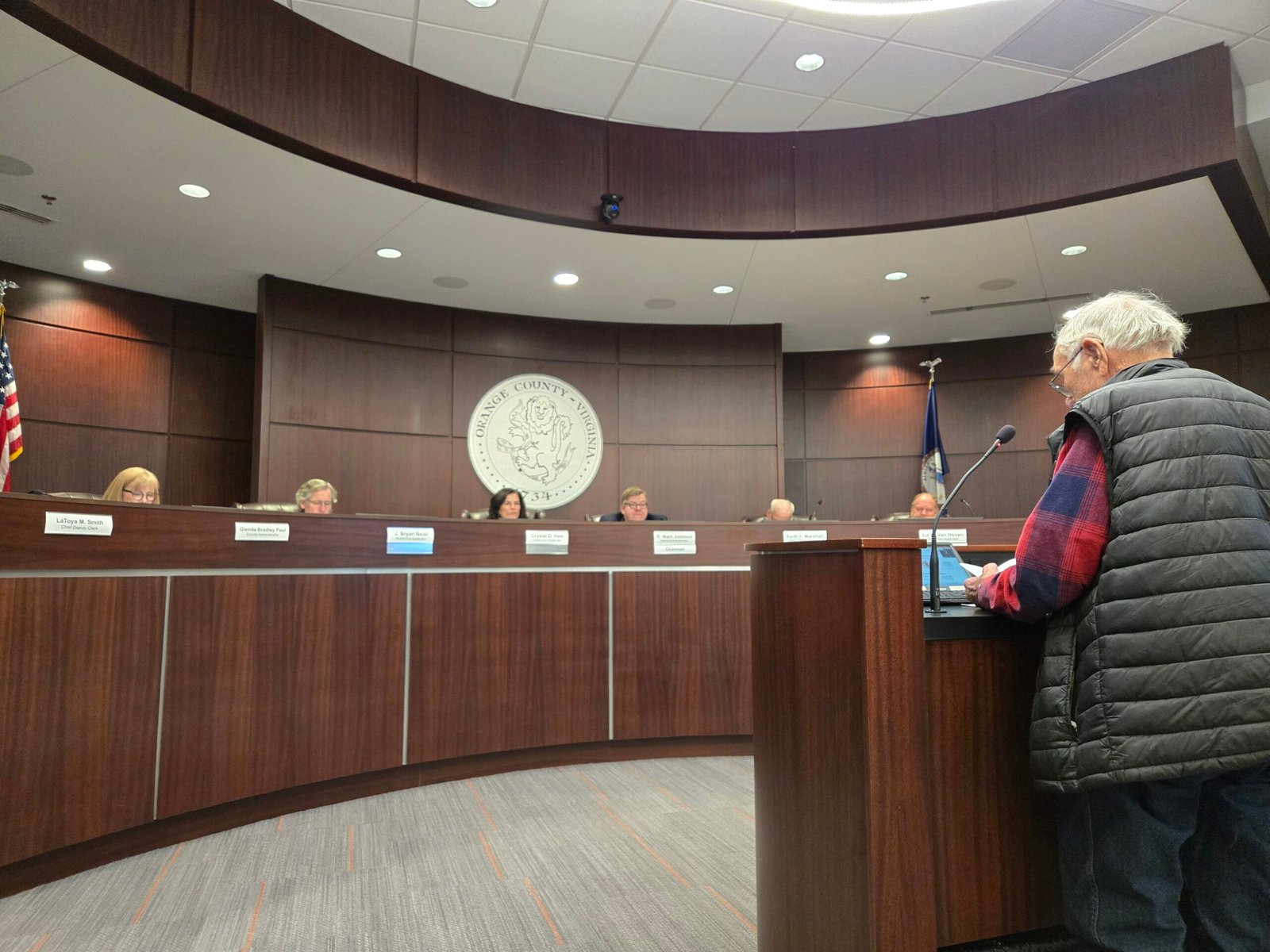
In what she called learning and listening to constituents, Orange County District 4 Supervisor Crystal Coleman called for a pause Tuesday night on data center projects in the county.
For months, residents have continued to question Orange County Supervisors about alleged back door dealings and point out what they say are flaws in the county’s technology zoning district.
In December, supervisors approved a new technology zoning district to accommodate high-intensity technology-based uses including data centers, technology schools or colleges and technology research and development facilities. Four uses are allowed by special use permit (SUP)–on-site power generation, a public utility facility not including utility-scale solar, a telecommunications tower and a data center. The district is floating, a term much maligned by supervisors, and could be applied to any suitable property through a rezoning. It sets forth larger setbacks and buffers as well as height restrictions and sign regulations. The use of public water, groundwater or potable water is prohibited. Additional regulations added by the planning commission in response to public feedback were removed by supervisors including the requirement of quarterly utility usage reports and a 1,000 feet setback from an occupied residence. Residents utilizing the Freedom of Information Act (FOIA) allege emails confirm those additional regulations were removed after feedback was received from those in the data center industry.
Since its approval, county residents have questioned the zoning ordinance, stating it lacks specific guardrails and should be applied to a designated area rather than be applicable to any qualifying parcel via a rezoning. Further FOIA requests of county emails and other records have led residents to determine supervisors not only knew about the potential of a 765kV transmission line coming to the county, but identified potential properties for hyperscale data center development.
During Tuesday’s board of supervisors meeting, Coleman, in an item added to the agenda after its publication, made a motion to pause data center development and send the highly-criticized technology zoning district back to the planning commission for refinement. She said the need for the pause would be for the health, safety and welfare of the community. Supervisors have said multiple times that no data center applications have been received by the county.
District 5 Supervisor and board chair Bryan Nicol seemed to be taken off guard by the mention of a pause, stating when he had spoken to Coleman via telephone she only said she was looking to send the technology zoning district ordinance back to the planning commission.
“You didn’t mention anything about a pause,” he said.
Nicol said she had misrepresented her intentions. Coleman disagreed stating she had clearly included what she was planning in her motion adding the item to the agenda. When Coleman began explaining why she would ask for a pause and to refer the ordinance back to the commission, Nicol called a point of order.
“You can’t just talk,” he said. “Make a motion so we can all understand what your motion is and we can all proceed.”
Coleman stated her motion would be to refer the document back to the planning commission for additional review and recommendations regarding the concerns raised by both the board and residents including the district’s location and acreage, residential setbacks, power generation and consumption, utilization of existing infrastructure, wastewater discharge and noise standards with a pause on all future applications “until such time when we have had the opportunity for the planning commission to refer [the ordinance] back to the board and the board take appropriate action.”
The motion failed for a lack of a second and the board moved on to the next item on the agenda. However, during board comments, Coleman further explained her position. She said over the past eight months, she’s learned a tremendous amount about data centers, their power consumption and the implications of high voltage transmission lines.
“I’m not too proud to say when I believe it is time to revisit an issue,” Coleman said. “Sometimes the most responsible thing we can do is pause, take what we have learned, listen to the community and ensure the policies are strong enough to protect [what we have.]”
She said future development could contribute to the need for additional electrical infrastructure such as high voltage transmission lines and it would be reasonable to minimize that need. She said there are important questions that deserve additional consideration and she believes a balance could be found to ensure responsible economic development while maintaining the county’s rural character.
“An engaged community can make progress better,” Coleman said. “Public input can identify concerns we may not have anticipated [and] challenge and create stronger policy. We owe it to the community to pursue responsible economic development.
“If Orange County chooses to participate in [data center development], our policies must be stronger and must protect our residents, landscape, infrastructure and future,” she added.
If her motion had passed, Coleman said she would have asked the planning commission to consider landing the district in an area and evaluating acreage, if setbacks from a residence should be increased from 500 feet to 1,000, power generation and consumption and noise mitigations.
“I don’t view this as stepping away from progress,” she said. “I view it as a deliberate pause to make a difference, listen to constituents and create something that protects Orange County.”
During public comment, resident Bonnie Fincham supported the idea of a pause, expressing her frustration. She said residents keep voicing their concerns and are being ignored.
“It’s like you have an agenda, you know what you want to do and what people are saying doesn’t make a difference,” Fincham said. “A pause needs to be in place. There are problems with data centers and we’re just sweeping it under the rug. I’m disappointed in you all for that.”
Meanwhile, supervisors unanimously approved a set of planning commission recommended changes to the comprehensive plan, strengthening it in the fight against Valley Link. The changes added additional statutory language, expressed that lines should be placed among existing right-of-way, requested early notice of potential projects and meaningful consultation, and placed underground when feasible.

