

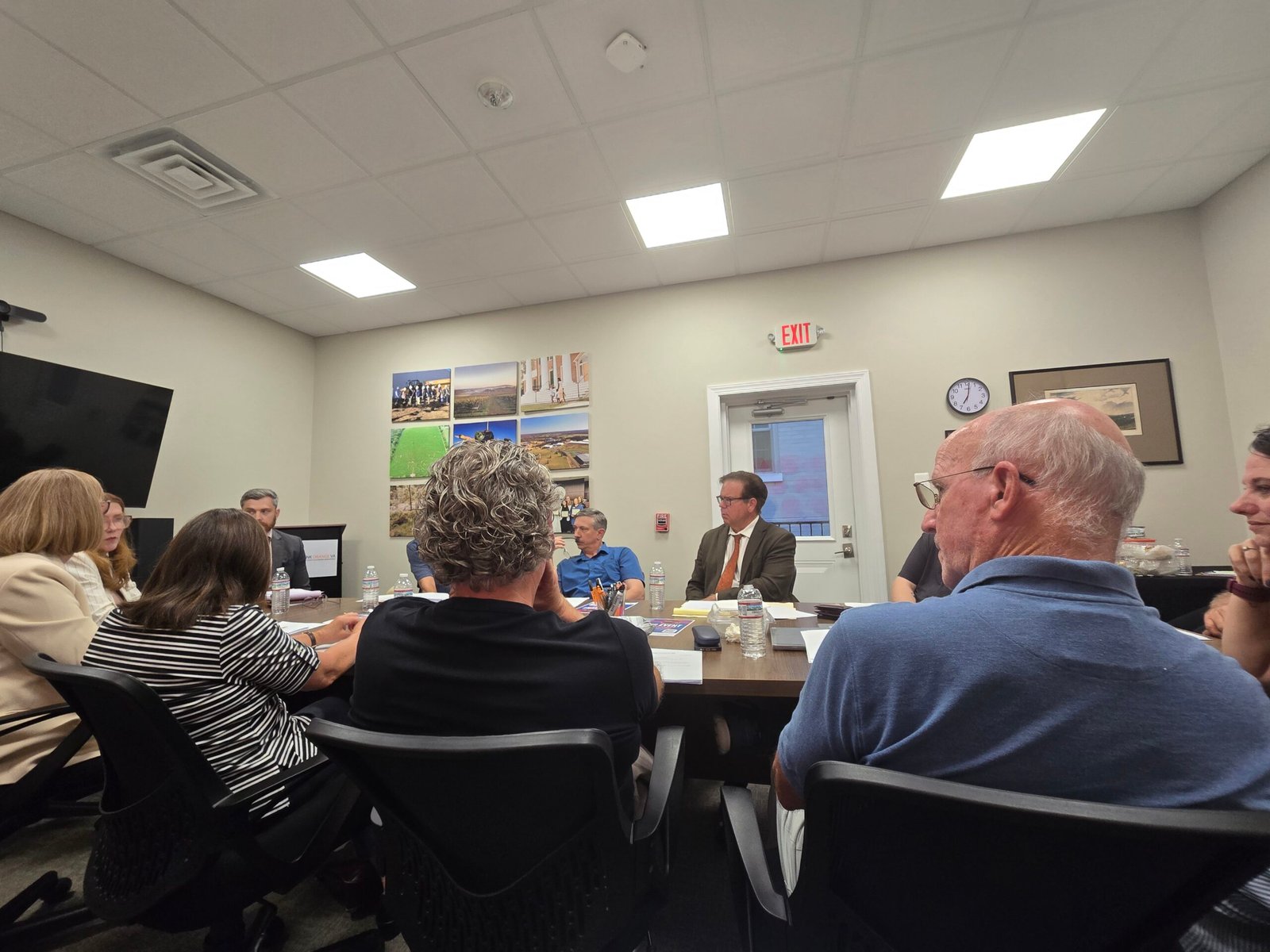
Data centers are a hot topic in Orange County, this time at the latest economic development authority meeting.
On Wednesday, the EDA discussed data centers for what members said is the first time. The topic was placed on the agenda via a motion by District 1 member Kevin Passarello. He said he felt bad that members of the public were attending the meeting, but couldn’t speak.
“Data centers have a lot more to do with economic development frankly than anything else on this agenda,” Passarello said.
The motion was seconded by Town of Orange member Anthony Schienschang and approved 4-3 with District 3 member Teresa Harris, chair and District 2 member Adam Bryington and District 4 member J.P. Tucker dissenting. Bryington questioned if the authority members would want to spend their time discussing an issue that isn’t in their purview.
“It’s an interesting thing as a board to get drug into a discussion you have not been a part of and have no vote on,” he said. “We could open ourselves up into wading into the administrative part we have no control over. Everyone who wants to do that has a forum to do that. If you want to come here and eat your sandwich and listen to items that have nothing to do with us, we can do that. I personally have no [desire] to do that.”
For months, county residents have utilized the Freedom of Information Act (FOIA) to connect dots surrounding data centers in Orange County, with emails and documents revealing what they call a concentrated data center recruitment campaign. Questions have arisen about the EDA’s potential involvement in the issue, but authority members say they’ve never had a conversation about the topic.
Speaking strictly as an authority member and representative of Town of Orange residents, Schienschang criticized the perceived opacity of some decisions facing the county. He said members of the authority have not been updated on important economic and industrial developments, including data centers, and have been pressured into voting on agreements without time to do due diligence.
“One would think the county’s public body charged with promoting industry and economic development in line with the county’s comprehensive plan would be deeply involved in conversations about something as impactful to the tax base, resource use and health of our county,” Schienschang said. “I cannot understand why this body would be excluded from these discussions unless there was some underlying reason from the board of supervisors or county staff.”
He said based on the information released via citizen initiated FOIA requests, “it would appear as though the reason for this may have been because certain parcels and property owners appear to be receiving special consideration without public input.” Several released emails mention three specific properties for data center development within the county. Schienschang alleged two supervisors, particularly chairman and District 5 Supervisor Bryan Nicol and District 1 Supervisor Jason Capelle, had directly interfered with a landowner, not one of the three, who was working to market their property to data center developers. Nicol said he didn’t interfere with anything, but rather asked questions after constituents alerted him to the property.
The property owner was present at the authority meeting, but the county’s attorney quickly ended the conversation.
In an email Friday, Capelle said he, too, contacted the agent to ask questions and learn more. He found out the listed had been posted in November or December, but there had been no interest. He also said he alerted them to some incorrect information including that the county’s technology zoning ordinance wasn’t still in draft form and the listing had outdated Valley Link information with the route in Spotsylvania County.
“I don’t think any of that could remotely be categorized as ‘interfering with a contract’,” Capelle said.
Schienschang also advocated for greater transparency, stating if a proposal is truly beneficial to the county it should be able to withstand public scrutiny.
“The people of Orange County should not have to chase rumors, decipher carefully worded announcements or search through scattered documents to understand what their government is considering,” he said. “We must stop treating transparency as something that begins and ends with minimum legal compliance. The question should not be, ‘What are we legally required to disclose.’ The question should be, ‘What information do the people of Orange County reasonably need to understand what their government is doing in their name?’”
Schienschang said residents and authority members need clear answers about project tax revenues of projects, incentives and public expenditures being considered, necessary infrastructure improvements, who will bear risks and more. He also said the authority is not meant to be a “ceremonial stamp of approval” and has a duty to exercise independent judgement ensuring a project serves the county.
Passarello, who has worked in the tech industry since 1989, said he’s concerned that the board has never discussed data centers.
“It’s something that merits this board’s discussion when staff is working on data centers,” he said, acknowledging that staff members are likely in a tough spot and are being told what to do by people other than the authority. Passarello said a balance has to be struck in the context of data centers about how much the authority should know and what the staff should know about the authority’s opinion on the matter.
District 5 authority member Tom Neubig said it would be worth the EDA members learning more about data centers so they can inform the supervisors about any issues that may need to be grappled with.
Town of Gordonsville representative Laura Mahan said more transparency leads to more trust and if people keep voicing the same concerns, they feel like they aren’t being heard.
Tucker said he’d like to have more unbiased information about data centers, including their tax value for residents.
“Are they the worst thing to ever happen or are they on 1,000 acres out in a field and can hardly see it, but it’s generating tax revenue,” he asked.
Bryington said data centers don’t become a topic of the EDA until an application has been received. He said a good sized data center can generate $60-100 million in tax revenue per year and utilizing 25% of that to give back to residents as a tax break would cut the tax rate by as much as 25 cents.
“That is real money to people in this county who don’t have money,” Bryington said.
He said he doesn’t think residents have been provided with information about what data centers could mean to them and said the county is behind the eight ball with messaging to residents. He also said he couldn’t determine if he could be for or against data centers until a specific project is presented.
“If it’s FOIA-able, the people of the county should know about it and not have to look for it via FOIA,” Bryington said. “The county needs a message to the citizens of the county, this is the direction they’re going and why they’re going there.”
During public comment, allowed after a motion made by Schienschang earlier in the meeting was approved, transparency was again the focus. Michael Regan questioned why the EDA hasn’t been involved in what seems to be the economic development thrust of the county. He said the topic shouldn’t be shrouded in secrecy. Sarah Regan agreed, stating it was terrifying that the EDA hasn’t had any say in the “huge campaign to bring industrial development into this county that will change it forever.” She said there has to be more transparency, alleging a closed loop with administration working with key players on the board of supervisors and forwarding information in executive session.
“Stop that,” she said.

