

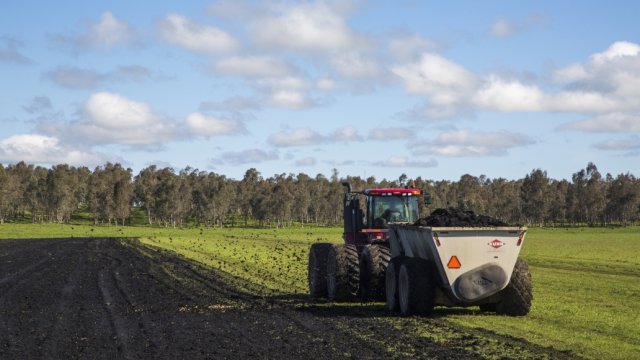
Months after the first public hearing, the Department of Environmental Quality (DEQ) held a second hearing regarding the spread of biosolids on agricultural land in Orange County.
In October, several residents voiced their concerns regarding an application by Synagro to renew its permit to apply biosolids on 2,564.9 acres of agricultural and silvicultural land at eight sites, 200 acres of which would be new land that isn’t included in the original permit, which expires July 12. The renewal, if approved, would be good for 10 years.
Biosolids or sewage sludge is produced by wastewater treatment plants during the process of removing contaminants. It’s treated to remove toxic contaminants before being dried and marketed to farmers by third-party companies like Synagro as inexpensive fertilizer. According to DEQ, “the permit authorizes the land application of biosolids and water treatment plant residuals as fertilizer on specific sites in the county and limits the application of nutrients, metals and pathogens contained in these materials to amounts that protect water quality and human health, in accordance with Virginia Pollution Abatement” regulations. However, the DEQ doesn’t include PFAs in their regulations.
Perfluoroalkyl and polyfluoroalkyl substances (PFAs) are man-made forever chemicals. According to ongoing research by the Environmental Protection Agency (EPA), exposure to PFAs may lead to adverse health outcomes. And they’re a major concern when it comes to biosolids.
During the October public hearing, residents spoke about PFAs and asked that biosolids be tested for their presence, and if found, not be applied to land in the county. Those comments were summarized and commenters were then invited to a second public hearing held last week to respond to the summary. No new speakers were allowed.
James McConnell again spoke in favor of testing for PFAs. He said the DEQ’s reasoning that testing isn’t necessary, is false.
“The department’s reasoning it doesn’t need to test because there’s no demonstrable problem with PFAs in the county [is false],” he said. “There’s no demonstrable issue with PFAs because there’s been no testing.”
He said the best indicator of the presence of PFAs is found through the testing of fish. Only two fish have been sampled in the county.
Board of supervisors chairman and District 5 supervisor Bryan Nicol reiterated comments he made in October, requesting the regulation of PFAs. He said DEQ has the authority to test biosolids for the chemicals prior to it being applied to any land. He asked that testing be funded by Synagro and the results of which be posted publicly. He requested that any biosolids containing PFAs not be applied to land in the county.
“When you allow the spread on Orange County property, [PFAs] never go away,” Nicol said. “We know at even extremely low levels they can cause significant harm to health.”
Don McCowan of the Piedmont Environmental Council asked the DEQ to require Synagro to test the water and soil for PFAs where biosolids have been applied and then utilize that data to impose restrictions that will protect residents’ health. He also asked that permits be reopened and subject to any new rules that may come out of the General Assembly.
This spring, a bill was approved that will require biosolid distributors to test for PFAs beginning Jan. 1, 2027. Any concentration of 50 micrograms per kilogram or higher will prohibit the material from being applied to land. Levels of 25-50 micrograms per kilogram will result in a reduced application rate.
It’s unknown how long it will be until the DEQ decides to approve, deny or modify the permit application. To view the summary of comments from the October hearing, visit https://www.deq.virginia.gov/home/showpublisheddocument/36415/639159913307970000. To view the permit application, visit https://www.deq.virginia.gov/news-info/shortcuts/public-notices/water/land-application-virginia-pollution-abatement-vpa.

