

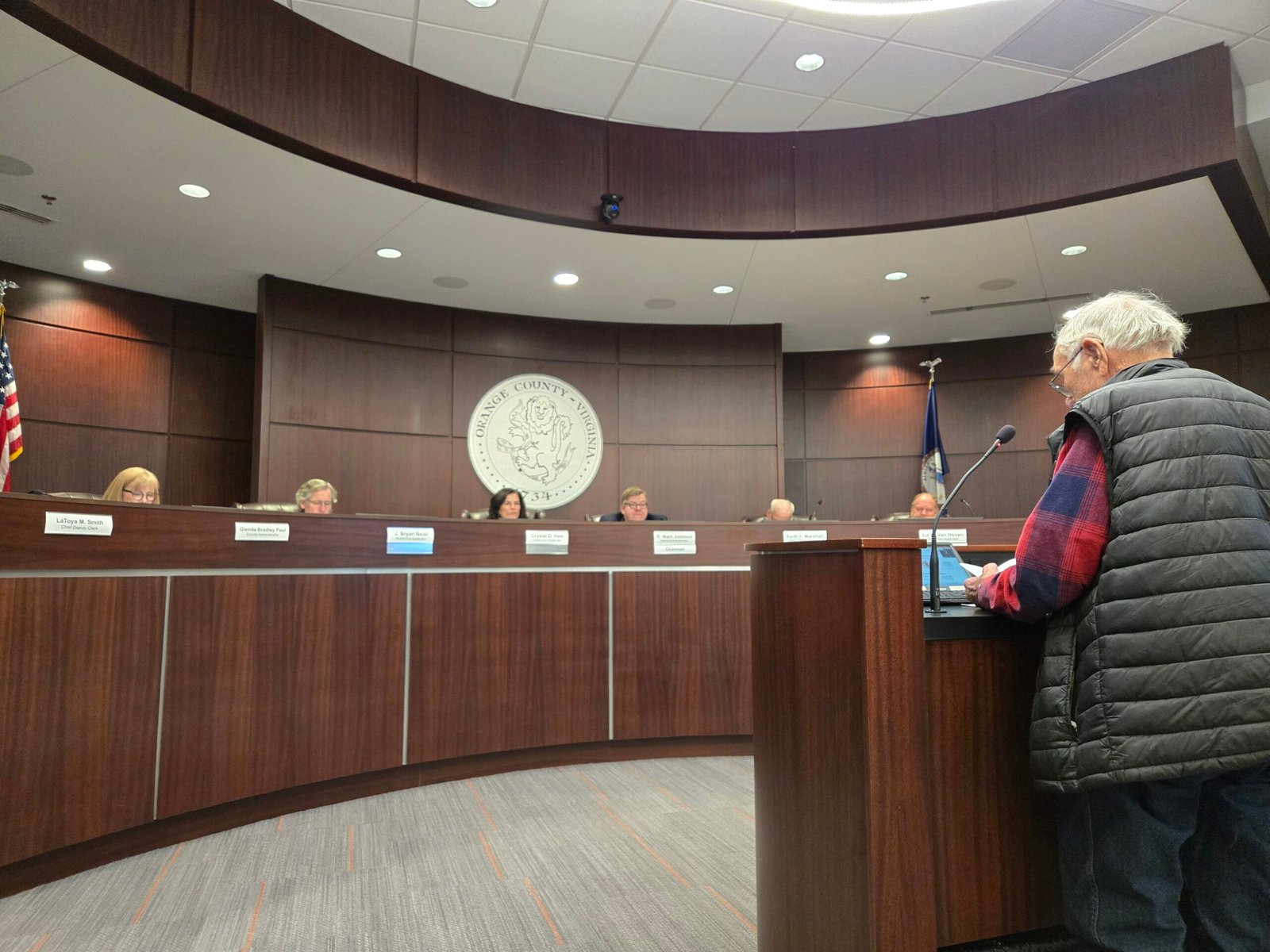
Orange County has a new technology zoning district following unanimous approval by supervisors Tuesday.
Earlier this spring, the Orange County Board of Supervisors passed a resolution to overhaul and amend the county’s zoning ordinance. The Berkley Group was retained to assist in the work with anticipated completion taking approximately 12-18 months. As part of the process, individual zoning districts are being discussed and worked on. The technology zoning district is one of those.
The district, which is being proposed through a zoning ordinance amendment, is intended to accommodate high-intensity technology-based uses including data centers, technology schools or colleges and technology research and development facilities. Three uses would also be allowed by special use permit (SUP)–on-site power generation, a public utility facility not including utility-scale solar and a telecommunications tower. Planning commissioners also revised the initial draft to add data centers to the list of uses requiring an SUP.
Other changes made by the commission include not allowing the use of public water, groundwater or potable water.
The zone sets forth larger setbacks and buffers as well as height restrictions and sign regulations. It’s also a “floating zone” and isn’t being proposed for one particular area in the county, but rather would be obtained through a rezoning. Rezoning applications offer opportunities for public feedback through public hearings and are evaluated by both the planning commission and the board of supervisors which ultimately decides the application’s fate. Currently, data centers are allowed by right in industrial zoned areas, offering little to no board oversight.
The planning commission held a public hearing on the district earlier this month, recommending it for approval to the board of supervisors with several amendments. Commissioners added a 1,000 foot setback from an occupied residence and a state or federally designated historic district. They also added a phrase requiring the water service plan to include information on the disposal of wastewater and quarterly utility reports that will be published for public review.
During the board public hearing Tuesday, residents shared many of the same concerns that had been shared at the planning commission hearing–noise, water use and the idea of setting a maximum county-wide acreage limit for the zoning.
Dave Davies of Locust Grove who is involved in the Virginia Data Center Reform Coalition said he was impressed with the zoning district restrictions. He said it was clear Orange County officials had learned from the mistakes of their Northern Virginia counterparts. He urged supervisors to act quickly to close the current byright option for data centers to locate in industrial zones.
“That is a hazard that could come up to bite us at any point,” Davies said. “Is this [draft] perfect? No. Is it better than nothing? Yes. This is not the last bite of the apple. What is here is good. I urge you to not let perfect be the enemy of good.”
Aaron Constien of Rapidan questioned what good could come of data centers. He said all he’s heard are negatives, voicing concerns about water and the idea of a floating zone.
Supervisors took issue with the term itself, stating in essence, all zones are floating zones, applied once a rezoning is approved.
“To call it a floating zone seems very confusing,” District 1 Supervisor Mark Johnson said. “Any zone can exist anywhere. If you add a piece of land currently zoned residential and want to come in and rezone it to industrial, that zone floats over there and lands on top of it. There’s really no difference.”
District 5 Supervisor Bryan Nichol said the board would be criticized if it selected a particular area of the county to designate as the technology zone.
Piedmont Environmental Council’s Don McCown voiced concerns about the floating zone, stating it essentially allows developers to request any parcel in Orange County to be rezoned to the technology district without the thought of its proximity to schools and scenic resources. He said floating zones are ones that don’t exist on a map and while providing a lot of flexibility for the locality, it also provides maximum flexibility for developers and could serve as a source of frustration. He encouraged a maximum cap on the amount of acreage countywide that could be rezoned into the technology district zone.
“I’m not aware of any locality in Virginia that allows an unrestricted floating zone for data centers anywhere in the jurisdiction,” McCown said.
Mary Hart Johnson and Bonnie Fincham questioned how data centers would benefit the county and its residents. Stella Bradford voiced concerns about the impact on federally protected species and the loss of farmland. Orange Town Council member Jason Cashell encouraged the protection of what makes Orange unique and said towns should be protected from the encroachment of data centers.
Mansour Azimipour, a developer in the eastern end of the county, said the setbacks included in the zone were too great and said the tax revenue from a data center would help to reduce the tax burden on residents.
Johnson said the county has worked to build strong standards for data centers and requiring an SUP allows board members to look at applications according to their individual situations, determining what conditional requirements are needed.
“It’s currently the wild wild west,” he said. “What we’re doing with the tech zone is bringing the sheriff in. Any bad guys coming in have to abide by these rules to get their foot in the door.”
District 4 Supervisor Crystal Hale said while the regulations in the zone aren’t perfect, it’s better than what the county currently has which is nothing.
“We have to have this protection,” she said. “We don’t have time to take a step back. What we have now is not acceptable.”
Nichol said the zone prohibits the use of potable, groundwater or water from rivers and aquifers. It also addresses setbacks and noise. He said it’s about land use and allows supervisors to analyze applications and make the best decisions for the county.
As for the amendments added by the planning commission, those were removed. District 2 Supervisor Ed Van Hoven removed the quarterly utility usage reports and the 1,000 feet setback from an occupied residence. He also suggested the arrangement of doors and windows be determined through the SUP process. Nichol increased the 500 feet setback from the Rapidan to 1,000 feet, keeping the 500 feet setback from perennial streams, but said either could be reduced by the SUP based on site-specific conditions. He also said the setback from a state or federally designated historic district should be determined by the SUP and instituted a 1,000 feet setback from any Orange County Public School building. The changes were approved 5-0 with supervisors then approving the district as amended 5-0.

