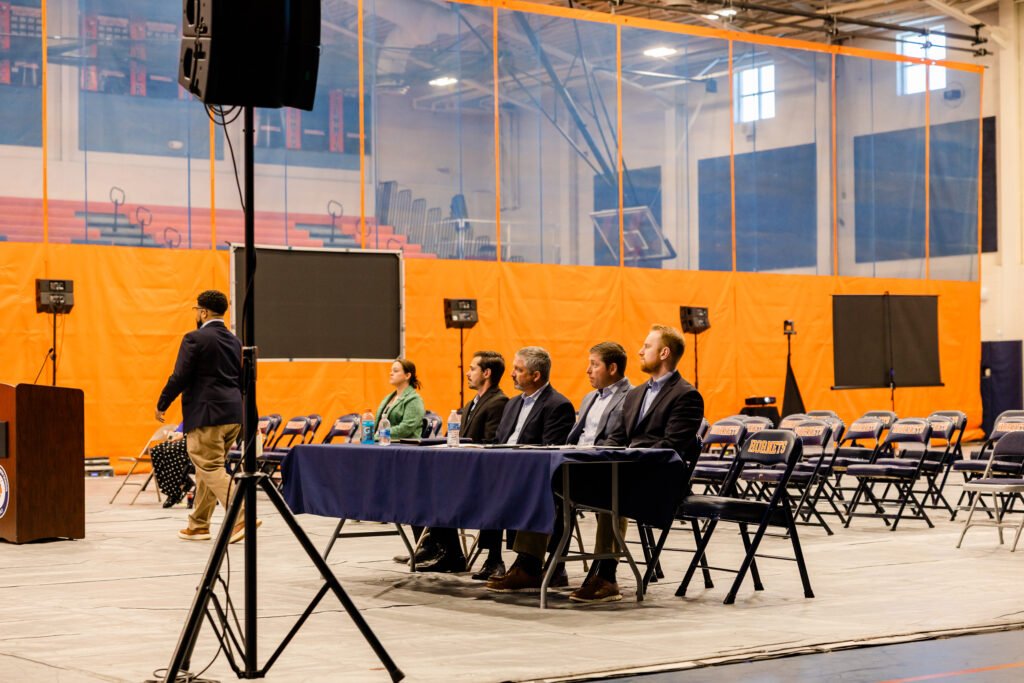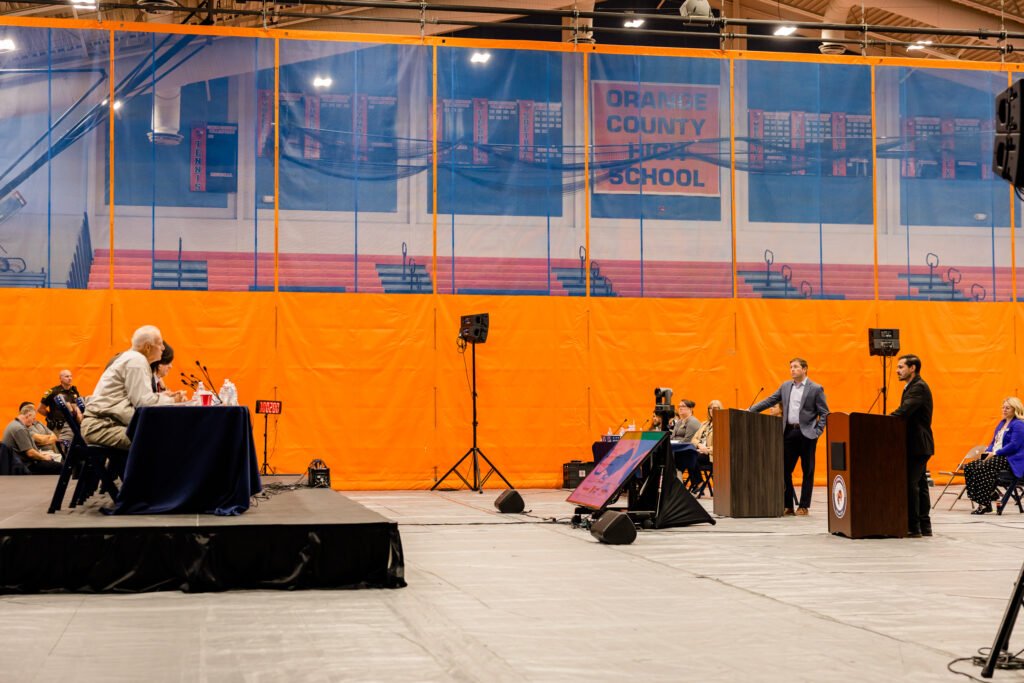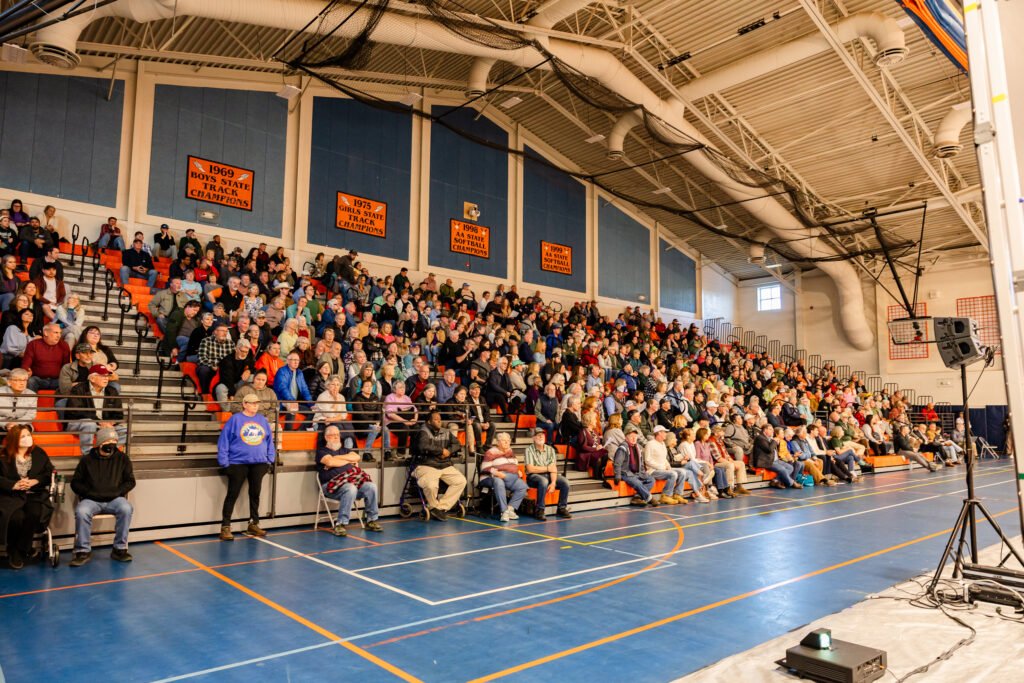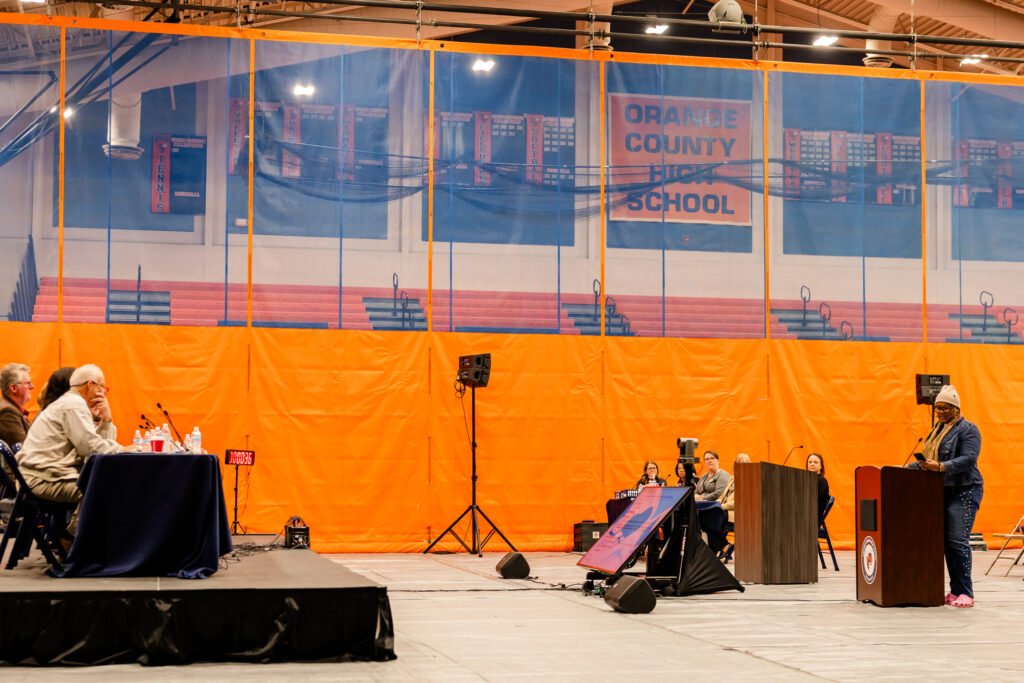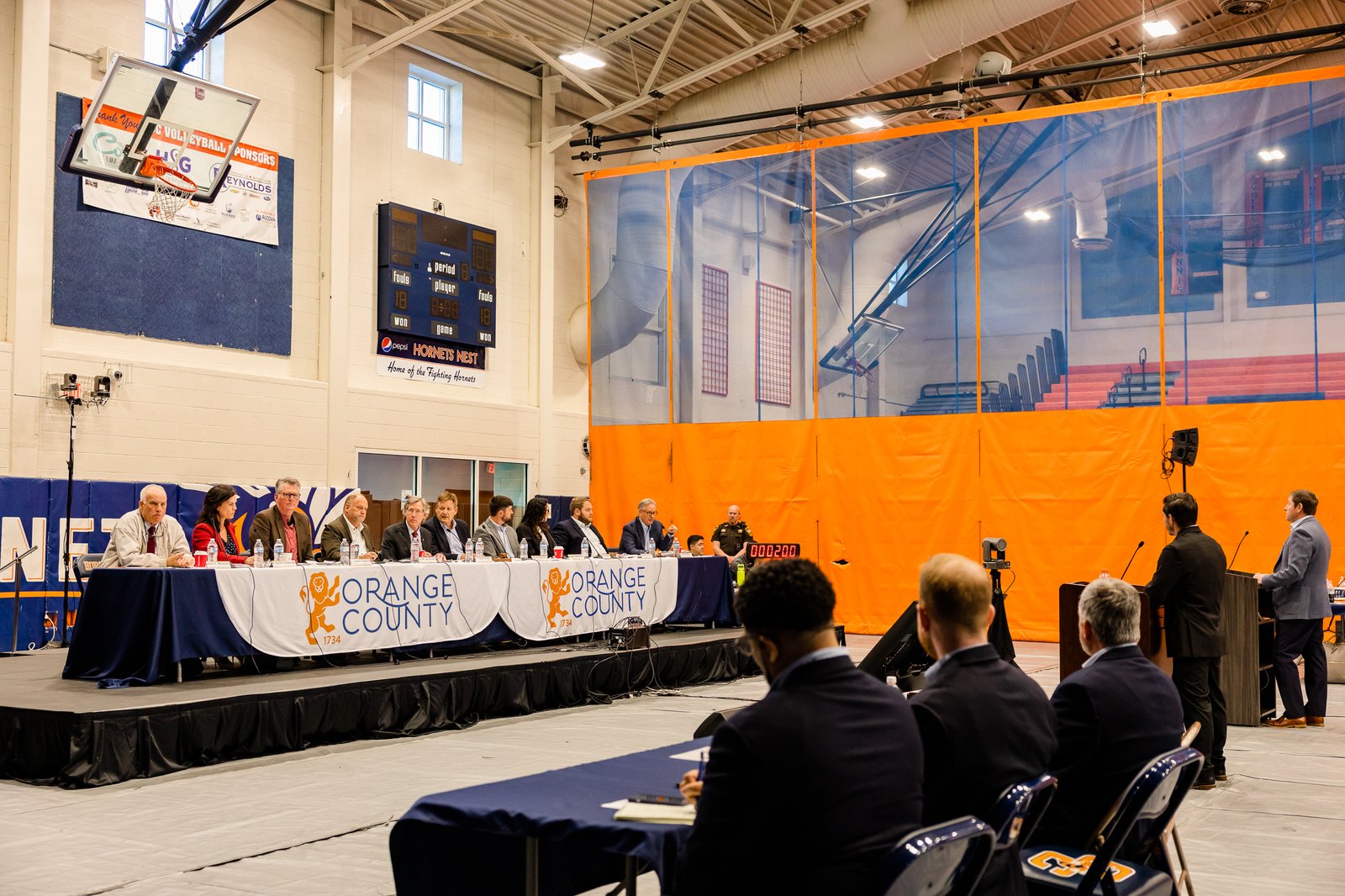
Hundreds of Orange County residents attended a meeting Tuesday to learn more about the Joshua Falls-Yeat Transmission Line Project from the source itself–Valley Link representatives.
The meeting, held by both the board of supervisors and planning commission, packed one side of the Hornet Sports Center for nearly five hours and featured a presentation on the project, questions and answers between board members and Dominion Energy representatives and public comment. Approximately 80 individuals spoke during the latter.
The Joshua Falls-Yeat Transmission Line Project is one of three proposed by joint venture Valley Link and approved by regional transmission organization PJM Interconnection. It would build approximately 115 miles of 765kV transmission lines from Campbell County to Culpeper County with preliminary routes crossing up to nine localities, including Orange County. At 765kV, the transmission lines are the highest voltage, highest capacity transmission line type available in the country and would include structures between 135 and 160 feet tall requiring approximately 200 feet of right-of-way. Dominion Energy’s Adam McGuire said the lines have the capacity to carry the equivalent of four times the power North Anna generates. The nuclear power plant has a capacity of approximately 1.8GW and provides approximately 17% of Virginia’s energy.
Valley Link representatives have said the project is needed to solve grid reliability issues amid unprecedented growth in the demand for energy. The project would allow power being generated in the Ohio River Valley to be accessed in Northern Virginia, which, according to the Northern Virginia Regional Commission, has the highest concentration of data centers in the world.
Routing
Initially, the Joshua Falls project included more localities with the Yeats substation being placed in Fauquier. That changed as the routing process began. McGuire said the northern piece of the project was found to have the largest impact on homes which is why the substation was moved to Culpeper. He said that switch had no impact on the routes in Orange County. He also noted that the line through Fauquier would have necessitated the taking of homes, which he said Dominion doesn’t do.
District 1 Supervisor Jason Capelle questioned how the substation change wouldn’t impact the route.
“If the substation stayed in Fauquier, the path through Orange County wouldn’t change,” he asked. “You would have went through Orange County and around Lake of the Woods? If that’s the case there’s something else about Orange County causing you to go through it.”
In looking through the goals Dominion has for placing transmission lines, Capelle said the only one the county has is open land.
“We don’t have existing structure or future land use; the only thing we have is large tracts of land which we spend a lot of time protecting, some of us for a lot of our lives and you’re going to come along and destroy it,” he said. “When you go through this list, we’re like the worst choice. When you go through these opportunities, we don’t have any of them except large tracts of land.”
McGuire said Valley Link also evaluated possible substation locations in Spotsylvania as well as Culpeper. Unlike in Fauquier, the Culpeper Yeats location is near existing 500kV lines. The 765kV line will be able to connect to those as well as any future lines. McGuire said the Culpeper location is also surrounded by timberland, giving the ability to create strong buffers and keep the development away from residences. Dominion has asked PJM to approve the new substation location. A decision is expected in April.
Also, the first thought was to follow existing right-of-way, but because those areas already contain lines and many have had adjacent development, it’s not feasible to do so. In Orange County, the Joshua Falls-Yeat Transmission Project utilizes 100% greenfield or open space. County officials said this is in direct contrast to the county’s comprehensive plan which states that transmission lines should utilize existing right-of-way.
Greg Mathe, Dominion Energy’s Director of Electric Transmission Engagement, Permitting and Land, said the proposed routes do parallel some linear infrastructure such as the existing pipeline.
“To have 200 feet of right-of-way, [which is required by the height of the structures], we had to go in open space,” he said.
“It seems to me if you go through land that doesn’t have [existing] right-of-way, it’s impacting more,” District 1 Supervisor Jason Capelle said.
District 3 planning commissioner Jordan Marshall said the project isn’t in the interest of Central Virginia, but rather those who stand to make a profit off data centers.
“The benefit goes to someone down the line who doesn’t bear the cost of getting the line,” he said.
Going underground
Dominion is currently working on a project to place a 185-mile 525kV underground transmission line to push power to Loudoun County. That HVDC line is different from the Joshua Falls-Yeat line in that it is direct current, not a standard, three-phase alternating current transmission line. More than 98% of the country’s transmission system utilizes AC lines because they’re easier to step down to different voltages via transformers for distribution.
McGuire said the two projects are aimed at solving different problems. With DC power going straight from point A to point B, nothing can be connected off of it along the way.
“The goal with this [Joshua Falls] project is to really give a high-capacity backbone to reinforce the electric grid throughout Central Virginia and tie existing lines in,” he said. “The HVDC is taking a strong source of power generation in Brunswick County and connecting it to a strong load [need] in Loudoun County.”
At the town hall meeting held at Lafayette Station, Dominion Energy’s Craig Carper said undergrounding is also costlier. The Joshua-Yeats line, if placed underground, would increase from $1 billion to $20 billion or more. The bigger issue, he said, is that the technology to underground a 765kV AC transmission line doesn’t exist.
“It’s never been done,” he said.
So what about placing two HVDC lines underground instead of the 765kV line? McGuire said it has a higher cost and the State Corporation Commission, who has final approval over the project, takes into account impacts on rate payers. However, with enough money, he said, most things are possible.
District 4 Supervisor Crystal Coleman said Dominion has a market value of $55-57 billion with an annual revenue of $15-16 billion.
“I ask you to bear the burden of cost and put this back underground so that these folks, many of [whom] are working day in and day out just to hold onto their land [don’t.],” she said. “You are a multi-billion dollar company. We don’t want the cost borne by our citizens in Orange County.”
Health risks
Planning commission chairman and District 5 representative Frank DePasquale asked about health risks associated with the lines.
McGuire said all transmission lines are designed according to national safety codes. He said many concerns seem to revolve about electromagnetic fields or EMF. He said Dominion follows the science of the issue with world health organizations and the EPA finding no evidence of a link between power lines, EMF and cancer. He said the company continues to monitor studies as the safety of its employees, which are more exposed to the lines, is paramount.
DePasquale disagreed. He said the EPA has stated there are reasons for concerns and cautions people to avoid high-voltage transmission lines with a particular emphasis on children who seem to be most affected.
Orange County Linda Roush expressed concerns about how her health and way of living might be impacted. Roush is deaf and relies on a cochlear implant to hear. She said research has shown high-transmission lines can cause audible buzzing and damage to internal electronics along with causing the external speech processor to malfunction or shut down.
“I want to continue to hear birds and frogs and crickets,” Roush said.
Impacts on farmland, property values and rural way of life
Many of those who spoke during public comment voiced concerns about the project’s impact on farmland, property values and their rural way of life.
Sixth generation farmer Katelyn Burner lives on Orange Springs Road. She and her husband just recently purchased their property and poured their resources into it.
“We’re at risk of losing our farm if this proposed line goes through,” she said. “The decreased value will eat away at the equity we’ve built. The folks that live in this county choose to live here [and] value the rural lifestyle and communities. Northern Virginia sees data centers as a cash cow looking to milk rural Virginia dry. We shouldn’t be asked to solve a problem that Northern Virginia created.”
Missy Chambers and her husband, Bob, own Brooke Farms, a multigenerational farm covering nearly 3,000 acres across three counties. Missy said the power line could affect hundreds of acres of farmland.
“Our family is proud to feed America,” she said. “Destroying productive agricultural land destroys America. The cost of produce and groceries will increase for all Virginians.”
Curtis Gish, who lives near the Locust Grove Primary and Elementary Schools, said two of the preliminary routes enter his property which he said will degrade his property values and destroy his family’s way of life.
“Why can’t these things be less invasive,” he asked. “Our time here is only a little piece of our time; this line will be here for generations. We won’t ever get over seeing this in our backyards.”
Michael Regan encouraged Orange County residents to stand strong.
“Electricity follows the path of least resistance,” he said. “Continue to make Orange County the path of resistance.”
Joe Cotton who lives in Unionville said he and his wife moved to Orange County in 2004 to build their dream home, pay it off and retire. He said one of the lines runs through the back of his property while another runs down a neighbor’s driveway.
“Either would destroy where we live and restrict what we can do on our property,” Cotton said. “A realtor said just having the proposal on the property drops [its value] about $100,000. It could drop as much as 42%.”
He said that the project is teaching children that no matter how hard they work for the right thing, there’s nothing you can do to prevent it being taken away.
A dream dashed
Zachary and Caroline Dayton have a dream to build a family compound on Pine River Road. Zachary’s father, Brian Dayton, purchased 32 acres of land, subdividing 10 for Zachary and Caroline. Meanwhile, Caroline’s parents, Herman Jr. and Beth Richards sold their house in the Town of Orange and purchased 10 acres adjacent to the Daytons.
Beth Richards said the property they purchased already contains a Colonial Pipeline easement. If the proposed transmission line runs through their property as currently proposed, the land will be rendered unusable. The Richards had already completed their home plans and received permits when they were alerted to the transmission project. The proposed routes converge and pass through the Richards’ land and Zachary and Caroline’s land.
“We placed all [our] plans on hold and now we’re stuck,” Beth Richards said. “We’re being controlled by something we didn’t ask for. We can’t sell the land, can’t move forward with building and we don’t have a timeline.”
“This will decimate our [family compound] dream and negate all the work that has been done to get there,” Zachary Dayton said.
Adding insult to injury, Caroline Dayton said the proposed routes also affect the couple’s home they built in 2023 on Indiantown Road.
“The route would be detrimental to our property value,” she said. “Our dream was to raise our future children next to their grandparents.”
“Country bumpkins?”
Several speakers asked why Orange County residents should have to pay for the sins of Northern Virginia. Former supervisor Terri Pace said the data centers needing the power should pay for the power. Coleman dispelled any notion that residents didn’t understand or weren’t paying attention.
“Orange County understands what is happening,” she said.
District 2 planning commissioner Brandon Van Hoven said Orange County shouldn’t be penalized for being rural.
“We shouldn’t be penalized for our rural way of life,” he said. “Just because there are less people here, we shouldn’t be impacted.”
Up next
The information gathered in the town hall and other meetings is being used to refine routing, said Dominion representatives. It will all be combined into one set of changes that will be reflected in an updated map on the project website that will be publicized once completed.
“That will be done before June,” Mathe said.
A second round of town hall meetings is planned for June. A notification process for landowners will take place this summer and Mathe expects communications to continue through the year. The company intends to submit an application to the SCC in September. The SCC process typically takes a year and involves opportunities for public input.
Orange County officials continue to mount their response to the project. Board of supervisors chairman and District 5 representative Bryan Nicol said the board will utilize comments from the meeting to develop ideas to be discussed at the April 14 board meeting. The board already submitted 28 questions to Dominion Energy and Valley Link, the answers to which were received just prior to the start of Tuesday’s meeting. The board may opt to submit additional questions and plans to take action. The first set of questions and answers can be viewed online at https://www.orangecountyva.gov/valleylinkquestions.
“This project is unacceptable,” Nicol said.
County officials are planning to attend a meeting next month that aims to bring together officials from the nine counties impacted by the project.
For more information regarding the Joshua Falls-Yeat Transmission Line Project, visit https://vltransmission.com/joshua-falls-to-yeat/.